Cryptocurrency has the world on its feet for the last decade. The ride in the currency’s value has remained consistent, and since Bitcoin’s development in 2009, several other similar companies have also taken form, creating the nickname ‘crypto’ for all digital currencies.
If you are unsure what cryptocurrency is or how it works, here is a breakdown.
Cryptocurrency is a digital banking system that takes banks from the equation and uses cryptography to verify and secure transactions. It enables anyone to send and receive payments anywhere. The currency exists digitally – you don’t own anything tangible – and transactions are recorded in a public ledger.
Cryptocurrencies run on what we call a blockchain – essentially a digital chain (imagine a spider diagram) of all transactions and account holders. The currency itself is developed by combining computer power and solving complex mathematical problems to create ‘coins’ – this is called mining.
Why Cryptocurrency is the Next Big Thing
When it comes to investing money, investors look at many factors, including risk factors and level of control over their money. Cryptocurrency investment has become so popular due to many advantages that investors find conducive to making money in the future.
Firstly, over time cryptocurrency will increase in value as experts see it as the future currency. Buying and trading cryptocurrency leads to a more significant return later than traditional investment options.
Removing banks from the equation also eliminates the risk of value reduction due to inflation. The blockchain is generally more secure than traditional transaction systems because of the processing and recording system.
Who Is Accepting Cryptocurrency for a Second Passport?
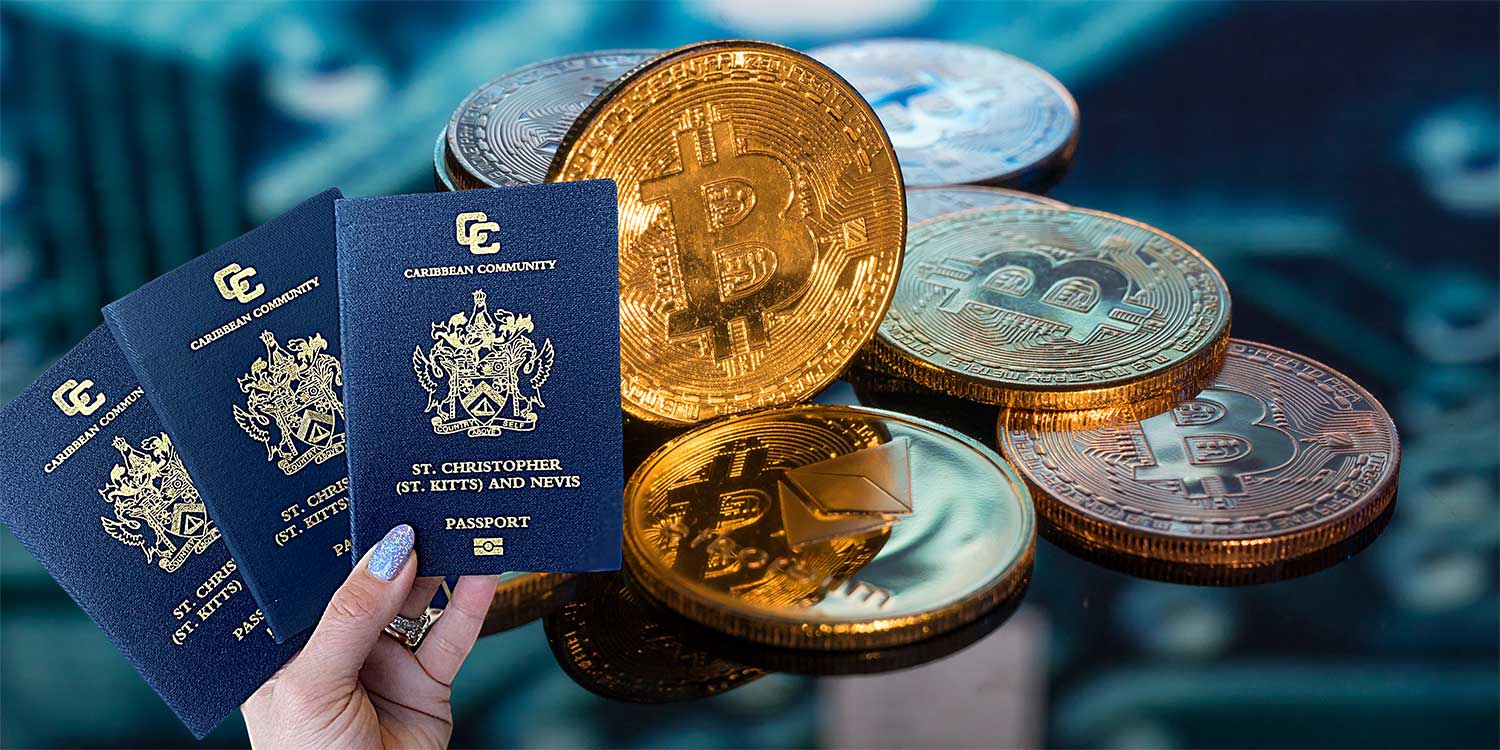
Countries are now jumping on the crypto train as they have noticed increased interest from foreign cryptocurrency investors. To draw foreign investors in, they are also looking at providing a wide range of benefits in the future.
With the Caribbean and Europe being the target destination for crypto investors, Armand Tannous, Vice President of North and Latin America for Apex Capital Partners, spoke to Yahoo Finance Live. Mr. Tannous stated that “crypto investors are specifically looking at St. Kitts and Nevis, Antigua and Barbuda, and European countries such as Portugal.”
Portugal offers ‘golden visas’ that is a residency by investment programs. Most of the Caribbean countries provide citizenship. These are the first few countries that accept cryptocurrency as a payment method for their citizenship and residency by investment programs.
If Antigua and Barbuda pass the bill, Antigua will officially be the first Caribbean country to accept cryptocurrency as a form of payment for Antigua citizenship. It is exciting because Antigua has a strong passport with visa-free travel to over 130 countries, no capital gains, no income or wealth tax on worldwide assets or inheritance, and no inheritance tax.
While more countries aim to accept cryptocurrency, investors can still convert their crypto into Fiat money and attain citizenship or residency.
Is Cryptocurrency a Good Investment?
Even though the value is soaring, and more millennials are explicitly investing in cryptocurrency, there are a few things to consider before spending your life savings.
Cryptocurrency is still volatile, which means the value fluctuates by the hour. Investors need to be prepared to lose all their money without any notice. And because it has only been around for a short period, it is still in the experimental phase of life – however, this doesn’t discredit the fact that it is here to stay.
If you have money to spare, cryptocurrency would be good to investigate for your investment. With the values steadily increasing over time, you will spend less money now than you will in five or even ten years. But as with everything finance-related, do your research and keep an eye on your investments to ensure it is still lucrative.










.webp)





























.webp)


.webp)















.webp)



















.webp)
.webp)